PCG Blog
19
March 2026
The Rise of the AI Content Studio: Why Quality Is the Only Currency That Matters
Roshan Mohan
Everyone has access to AI now. Every brand, every freelancer, every intern with a ChatGPT tab open can produce “content” in seconds. And that's precisely the problem. The barrier to creating content has collapsed to zero. The barrier to creating content that actually matters? That's higher than ever.
Welcome to the age of AI slop - and the brands that understand why it's a trap will be the ones still standing in five years.
The Flood Nobody Asked For
In 2025, global content output increased by an estimated 300%. Social feeds, inboxes, and search results are now saturated with AI-generated text that reads like it was written by a committee of algorithms - because it is. Perfectly grammatical. Structurally sound. And utterly forgettable.
This is what the industry has started calling “AI slop”: content that technically exists but adds nothing. It fills a content calendar without filling a strategic gap. It ticks a box without moving a needle. And audiences – your customers, your prospects, your stakeholders – can smell it from a mile away.
The irony is brutal. AI was supposed to make content better. For most brands, it's made content worse – not because the technology is bad, but because the application is lazy.
Why “More Content” Is No Longer a Strategy
For a decade, the content marketing playbook was simple: publish more, rank higher, win. Volume was the game. SEO rewarded frequency. Social algorithms rewarded consistency. And brands responded by building content factories optimised for output, not impact.
AI supercharged this instinct. Suddenly, you could produce ten blog posts in the time it took to write one. You could generate fifty social captions before lunch. The temptation was irresistible and most brands gave in.
But here's what the data is now showing: engagement rates on AI-generated content are plummeting. Google's helpful content updates are actively penalising thin, undifferentiated material. LinkedIn's algorithm is deprioritising posts that read like templates. And audiences are developing a finely tuned filter for content that feels manufactured.
The volume play is dead. The quality play is in.
What “Quality AI Content” Actually Means
Let's take a moment to define what “quality” means in this context.
Quality AI content is not content that “sounds human” or even looks human. It is where AI was used as an accelerant within a rigorous strategic framework, and not as a replacement for thinking.
It means the content was informed by genuine audience insight - not just keyword research, but a deep understanding of what your audience cares about, worries about, and aspires to. It means the content has a point of view - a perspective that only your brand can credibly hold, shaped by your unique expertise and experience. It means the content was crafted with intention – every paragraph serving a purpose, every sentence earning its place, every piece fitting into a larger strategic narrative.
This is the difference between using AI to think faster and using AI to avoid thinking altogether.
The AI Content Studio Model
This is why the AI content studio has emerged as the most effective model for brands that take content seriously. Not an agency that bolts AI onto old processes. Not a freelancer with a subscription to an AI tool.
A purpose-built studio where AI is woven into every stage of the content lifecycle – from strategy and research to creation, distribution, and optimisation - with human expertise guiding every decision.
In an AI content studio, the workflow looks fundamentally different from traditional content production:
Strategy comes first. Before a single word is written, strategists with deep industry expertise define the narrative architecture. What story is the brand telling? What position is it taking? What does the audience need to hear that nobody else is saying? AI accelerates the research phase – processing competitive landscapes, audience sentiment, and content performance data at scale – but the strategic decisions are human.
Creation is collaborative. AI generates initial frameworks, suggests angles, and accelerates production. But experienced writers, designers, and video editors shape the output – adding voice, nuance, cultural sensitivity, and the kind of creative spark that makes content memorable. The result is content produced at AI speed with human-grade quality.
Distribution is intelligent. AI optimises when, where, and how content reaches its audience. But the distribution strategy – which platforms, which formats, which audience segments – is informed by strategic thinking, not just algorithmic recommendations.
Measurement is meaningful. Instead of vanity metrics, an AI content studio tracks business outcomes: authority built, conversations started, revenue influenced.
The Cost of Getting It Wrong
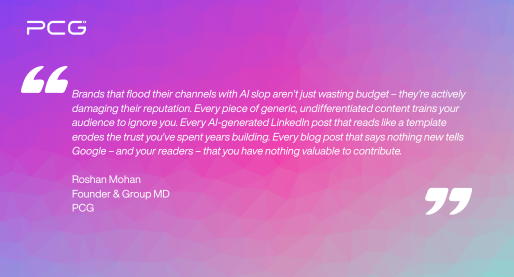
Brands that flood their channels with AI slop aren't just wasting budget – they're actively damaging their reputation. Every piece of generic, undifferentiated content trains your audience to ignore you. Every AI-generated LinkedIn post that reads like a template erodes the trust you've spent years building. Every blog post that says nothing new tells Google – and your readers – that you have nothing valuable to contribute.
In a world where AI makes it trivially easy to produce mediocre content, mediocrity is no longer neutral. It's negative. It signals that your brand doesn't care enough to do the work.
The Competitive Advantage of Craft
Here's the counterintuitive truth: AI has made human craft more valuable, not less. When everyone can produce competent content, the brands that invest in genuinely excellent content – content with depth, perspective, and creative ambition – stand out more dramatically than ever before.
Think about it. If every competitor in your space is publishing the same AI-generated content, the same templated social posts, the same generic blog articles – and you show up with content that has a genuine point of view, backed by real expertise, delivered with creative flair – you don't just stand out. You own the conversation.
This is the opportunity that most brands are missing. They are busy racing to produce more content and have forgotten to ask whether any of it is worth reading.
What to Look for in an AI Content Partner
If you're evaluating partners to help you navigate this landscape, here are the signals that separate a genuine AI content studio from a content factory with an AI subscription:
They lead with strategy, not tools. If the first thing a partner talks about is their AI stack, run. The technology is the enabler, not the value. The value is in the strategic thinking that directs the technology.
They have domain expertise. AI content without industry understanding is just sophisticated autocomplete. Look for partners who understand your market, your audience, and your competitive dynamics at a level that goes beyond surface research. This requires an understanding across various marketing disciplines including public relations, social media and of course, design.
They measure what matters. If your partner is reporting on impressions and likes without connecting them to business outcomes, they're optimising for the wrong thing.
The Bottom Line
AI has democratised content creation. It has not democratised content quality. The gap between brands that use AI thoughtfully and brands that use it lazily is widening every day – and audiences, algorithms, and business results are all reflecting that gap.
The brands that will win the next decade of marketing are the ones that treat AI as what it is: an extraordinarily powerful tool that is only as good as the strategy, expertise, and creative ambition behind it. They'll invest in quality over quantity. They'll choose craft over convenience. And they'll build content ecosystems that compound in value over time, rather than content factories that produce disposable noise.
The age of AI slop is here. The brands that refuse to participate in it will be the ones that matter.